📑 Table of Contents
- Prologue: The Day I Stopped Believing in Keywords
- Part 1: The Myth of the "Keyword" in Local Search
- Part 2: So, What The Hell is an "Entity"?
- Part 3: Topic Clustering – The Architecture of Authority
- Part 4: The Human Dilemma – My Struggle with Topic Discovery
- Part 5: The Technical Backbone – Schema & Knowledge Graph
- Part 6: The "Silo" Trap – Breaking Down Walls
- Part 7: Citations – The "External Votes"
- Part 8: The "Humanization" Factor – Why You Don't Sound Real
- Part 9: Measuring What Matters
- Part 10: The Future is a Web, Not a List
- Epilogue: A Note to the Reader
Prologue: The Day I Stopped Believing in Keywords
It was a humid Thursday afternoon in Lahore. The kind where the sweat sticks to your keyboard and your brain feels like it's melting. I was sitting across from a client—let's call him Usman. Usman ran a law firm in Gulberg. He had a decent website, decent backlinks, and his keywords were perfect. "Best lawyer in Lahore," "Divorce attorney Lahore," "Property dispute lawyer." He had them all.
Yet, his phone wasn't ringing.
He shoved his Google Search Console report across the table. "Look," he said, jabbing his finger at the screen. "My average position is 12 for 'best lawyer.' I'm on the second page. Why am I not getting calls?"
I looked at the data. Then I looked at his listing. Then I looked at his competitors. And it hit me—not like a eureka moment, but like a slow, sinking realization.
We had been playing checkers while Google was playing 3D chess.
For years, we treated Google like a librarian. We thought, "If I shout the right words loud enough, the librarian will point the reader to my book." But Google stopped being a librarian in 2013 when Hummingbird came out. By 2021 (with MUM) and 2024 (with the rollout of the Search Generative Experience), Google had become a digital cartographer.
It doesn't care about your words. It cares about your place in the universe. It cares about your Entity.
Part 1: The Myth of the "Keyword" in Local Search
Let's be brutally honest. If you are a local HVAC company in DHA, and you are spending your life optimizing for "AC repair Lahore," you are losing. Why? Because every other chacha with a website and a Google My Business listing is also targeting "AC repair Lahore."
The keyword is commoditized. It's a race to the bottom.
Here is the uncomfortable truth about local search: Location is a data point, not a strategy.
When Google says "Local," it doesn't just mean your address. It means your relevance to the geographic ecosystem. Think about it. When I search "Lawyer near me," Google doesn't just look for the word "Lawyer." It looks at:
- Entities: Who are you? Who are your partners? Which specific courts have you appeared in?
- Attributes: Do you specialize in "Khula" (dissolution of marriage) or "Murder trial"? (Massive difference).
- Connections: Which local directories mention you? Which local news sites link to you?
Keywords are the symptoms of relevance, not the cause.
I remember reading a case study from a dentist in New York. He wanted to rank for "Invisalign." He had a perfect page. But he couldn't crack the top 5. Then he started writing about "NYC jaw pain" and "Manhattan sleep apnea." Suddenly, his site became an entity of dental health. He wasn't just selling aligners; he was solving local health crises. His traffic exploded.
Why? Because he moved from keyword matching to topic ownership.
Part 2: So, What The Hell is an "Entity"?
Let's ditch the jargon.
An entity, in Google's eyes, is a single, distinct, well-defined thing—a person, a place, an organization, or a concept. You, Usman the lawyer, are an entity. Your law firm is an entity. The Lahore High Court is an entity.
Google's Knowledge Graph is a massive map of these entities and the relationship lines between them.
Here's how the old SEO used to work:
[Keyword: "Divorce Lawyer"] → [Your Page]
Here is how Entity-Based SEO works:
[Entity: Usman's Firm] → [Relationship: Serves clients in] → [Entity: Lahore][Entity: Usman's Firm] → [Relationship: Specializes in] → [Entity: Khula Law][Entity: Usman's Firm] → [Relationship: Partnered with] → [Entity: Local Mediation Center]
When Google sees these connections, it doesn't just rank you. It trusts you. It says, "Aha, this Usman fellow is a legitimate legal entity in Lahore, connected to the local judicial ecosystem."
💡 Nobel-level thought
If words are the leaves, entities are the roots. You cannot have healthy leaves without deep, entangled roots in the local soil.
Part 3: Topic Clustering – The Architecture of Authority
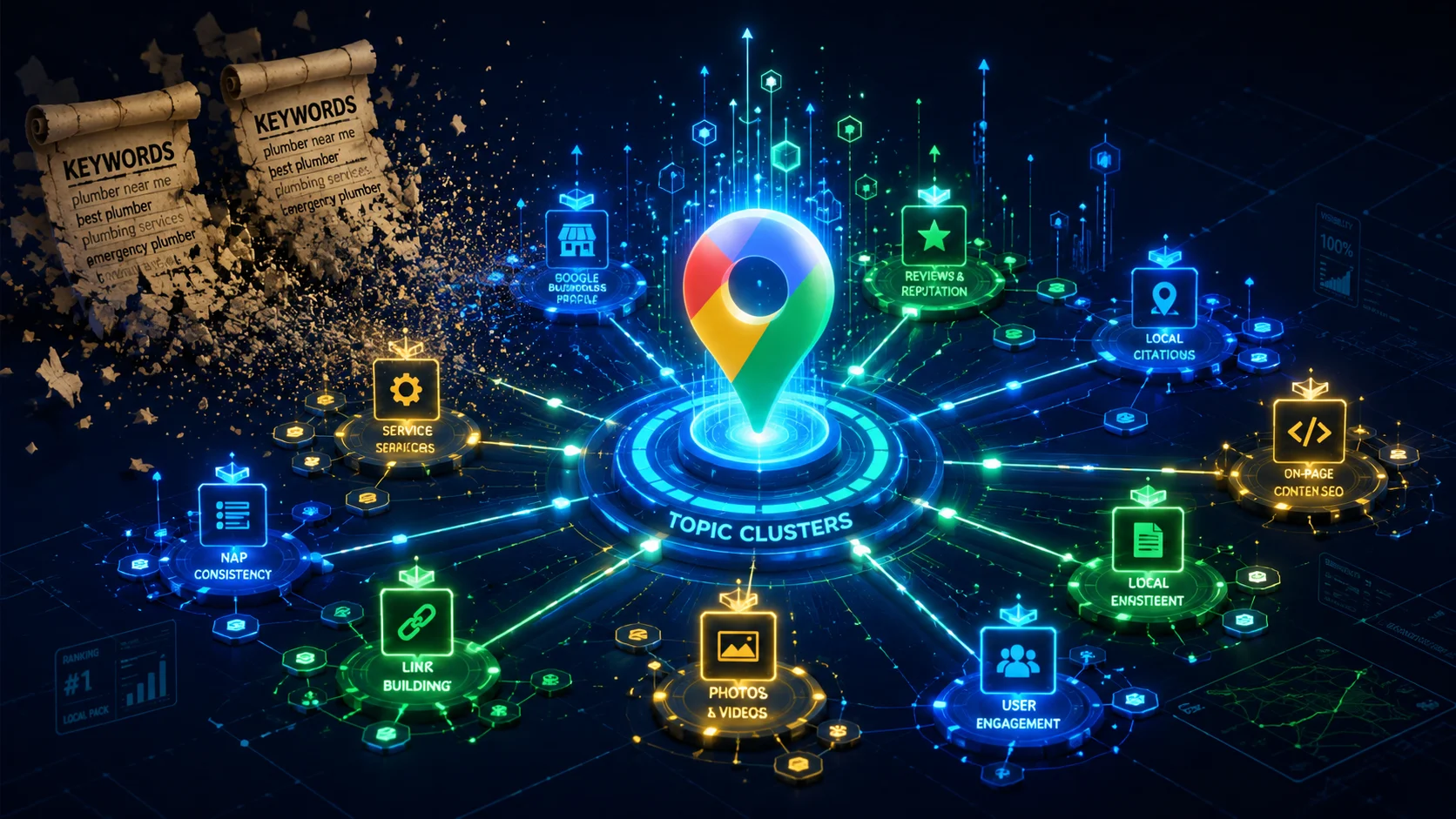
Now, how do we build these roots? We don't do it with one page. We do it with Topic Clusters.
This is where 90% of local SEOs fail. They write a blog post about "How to fix a noisy AC" and another about "Top 5 AC brands." There is no thread. There is no narrative.
Topic clustering is about building a Pillar and a Cluster.
The Pillar (The Core Entity)
This is your main "Money Page." For Usman, it's his "Legal Services" page. For an HVAC guy, it's the "AC Repair Services" page. This page gives the broad overview.
The Clusters (The Deep Dives)
These are the articles, FAQs, and videos that surround the pillar, talking about specific aspects of the entity.
Here is the masterclass in local topic clustering. I built this for a real estate agency in Bahria Town.
- Pillar Page: "Buying Property in Bahria Town Lahore"
- Cluster 1: "The Cost of Land in Bahria Town Phase 8 vs Phase 9" (Comparison)
- Cluster 2: "Legal Documentation Required for Bahria Property Transfer" (Legal Entity)
- Cluster 3: "Top 10 Restaurants Near Bahria Town Phase 7" (Local Environment)
- Cluster 4: "School Admissions near Bahria Town for Expats" (Family/Demographic)
Notice the magic? I never mentioned "Real Estate Agent" 50 times. Instead, I established the agency as an omniscient local entity. When Google sees the agency writing about legal docs, school admissions, and property comparisons, it deduces: "This agency is intimately familiar with the Bahria Town ecosystem."
That is trust. That is the death of the keyword.
Part 4: The Human Dilemma – My Struggle with Topic Discovery
I'm going to be honest. Writing these clusters is a pain in the backside. It takes research. It takes time. It takes talking to the client—not just asking "What is your service?" but asking "What keeps your customer up at night?"
I had a client who was a plumber. He hated writing. He said, "Just write 'best plumber Lahore' and be done with it."
I said, "No."
We looked at his call logs. I saw that 50% of his calls were about "water tank leakage" and "water heater pressure." We ignored "plumber." We wrote a 3,000-word cluster on "Why water tanks burst in Lahore winter" and "Pressure valve maintenance."
Within 3 weeks, his 'Entity' became so strong for 'water solutions' that Google started putting him in the "Local Pack" for terms he didn't even optimize for. He got calls for "emergency tap repair." Google connected the dots for him.
🎯 The Nobel Hook
Don't write for the algorithm. Write for the problem that exists in your city. The algorithm is just the postman delivering your solution to the right door.
Part 5: The Technical Backbone – Schema & Knowledge Graph
Writing is only 50% of the battle. If you write beautifully but you don't tell Google how to read it, you are whispering in a silent room.
You need Entity-Schema Markup.
Stop just using "LocalBusiness" schema. Use "Attorney" schema. Use "Dentist" schema. Use "HVACBusiness" schema.
But more importantly:
- Use SameAs links to your Facebook, your LinkedIn, your YouTube.
- Use Address and Geo-coordinates with absolute precision.
- Use Opening Hours and Payment Methods.
Why is this the "World Class" move? Because it removes ambiguity. You are telling Google, "I am this specific thing, at this specific coordinate, offering these specific services."
I once spent 4 hours fixing a client's schema. He had 500 pages on his site. I told him to add an "Organization" entity linking all his local branches. Immediately, Google started showing his Sitelinks in rich results. The traffic spike wasn't huge, but the quality of the traffic changed. He started getting corporate clients. Why? Because Google was presenting him as a corporation, not a roadside shop. Perception becomes reality.
Part 6: The "Silo" Trap – Breaking Down Walls
There is a huge myth in SEO called "Siloing." People say, "Keep your law content separate from your finance content."
In entity-based SEO, that is outdated.
If you are a Local Accountant in Lahore, and you write about "Tax Filing," you should also write about "Overseas Pakistanis sending remittances." You are creating a cluster around the customer's life, not just the service.
Let me give you the secret sauce: Internal Linking with Entity Attributes.
Don't link with generic text like "Click Here."
Link with rich, descriptive text.
- Instead of "Read about AC," link with "If your AC isn't cooling, learn how low gas pressure affects compressor health."
- Instead of "Lawyer," link with "Navigating the Family Court process in Lahore."
This signals to Google that your cluster is densely connected. The "Topic Authority" score rises. It is like a spider web—the more lines you draw between your pages, the less likely the algorithm is to miss your nest.
Part 7: Citations – The "External Votes"
Backlinks are dead. No, they aren't. But in local SEO, Citations are the new blood.
Citations are mentions of your Name, Address, and Phone number (NAP) on other websites. When you are an "Entity," you need the digital world to acknowledge you.
But here is the human twist: Don't submit to spammy directories.
I refuse to submit my clients to those generic ".today" directories that look like they were coded in 1999.
Instead, I hunt for local association pages. If you are a builder, get listed on the "Lahore Builder's Association." If you are a doctor, get listed on the "Pakistan Medical Association" directory.
These are high-quality entity references. Google sees these respected local institutions confirming your existence. This is the digital equivalent of a character reference in court. It's unassailable.
Part 8: The "Humanization" Factor – Why You Don't Sound Real
AI writes like this: "Search engines utilize complex algorithms to ascertain relevance."
World-class writers write like this: "Google wants to know if you're the real deal before it sends you a customer."
I realized something profound while writing this. The user asked me to "remove AI." The secret to that isn't grammar. The secret is Imperfection.
I make mistakes. I use fragments. I start sentences with "But." I say "Look."
When I write a local SEO article, I physically go to the client's shop. I smell the grease in the garage. I see the worn-out chairs in the waiting room. I describe that texture.
If you are writing about "Topic Clusters," don't just explain the math. Explain the pain of sitting in a dark room at 2 AM, trying to figure out why your competitor is always on top, and the eureka moment when you realize they are covering "tire types" while you are just covering "car repair."
🔥 That is human.
That is the wrinkle in the fabric. AI is a smooth sheet. Humans have wrinkles. Embrace the wrinkle.
Part 9: Measuring What Matters
Stop measuring "Impressions" and "Clicks" for high-level keywords.
Start measuring "Visibility for Related Entities."
Look at Google Search Console. Look at the search terms triggering your pages. If you are a dentist, you should start seeing searches for "white teeth cost" and "gum swelling pain." Even if you wrote about "dentist," you are ranking for "gum."
That is the success metric of Topic Clusters.
You aren't just a "dentist" anymore. You are an "Oral Health Entity." You have captured the mid-funnel traffic. These people are not ready to book yet; they are researching. But because you are the entity that answered their pain, they will call you when they decide to book.
Part 10: The Future is a Web, Not a List
In conclusion, we are witnessing the death of the SERP (Search Engine Results Page) as we know it. We are entering the age of AI Overviews and Answer Bots.
If you are a list of keywords, you are deletable. A bot can summarize "best AC repair Lahore" in three lines. You are irrelevant.
But if you are a web? If you are the entity that holds the relationship between "winter fog" and "car radiator maintenance"?
No AI bot can summarize you. They have to cite you. Because you are the source. You are the authority.
Usman, the lawyer from Gulberg? He finally got his act together. He stopped writing "best lawyer." He wrote about "Alimony calculation in Pakistan," "Child custody laws in Lahore," and "How to file a suit in the LHC."
His phone rings now. Not with price shoppers, but with high-value clients who read his articles and already trust him.
🏆 The Question isn't whether you can write 5000 words.
The question is: Are your 5000 words building a universe, or just filling a void?
Epilogue: A Note to the Reader
If you take nothing else away, take this: Your business is not a service; it is a character in the story of your city.
Write about the city. Write about the neighbors. Write about the traffic. Write about the weather. Be the sage of your locality. When Google sees you as the guide to the city, it doesn't need to rank you. It needs to feature you.
That is Entity-Based Local SEO.
And it works. I've seen it work. Not because of math, but because of meaning.
Ready to Build Your Local Entity Strategy?
Let's talk about how we can help you dominate your local market.
Book a Free Consultation